

The Four Important Factors to Consider:
Although we only list four factors in this post, there are many other things that can and do affect your handheld radio & its performance. Handheld radio improvements can be inexpensive and some of them are FREE as you will learn below! We will focus on the following four as they are most significant.
1. Frequency Matters: VHF vs. UHF
Most typical Handheld HAM radios use two frequency bands, Very High Frequency (VHF) and Ultra-High Frequency (UHF). If we talk about the VHF waves, they travel much farther and penetrate objects better than UHF frequencies. The UHF signals, on the other hand, are shorter. VHF is also called the 2 Meter or 146 MHz band; UHF is also called the 70 cm or 440 MHz band.
The wavelength for 2 Meters is 78.7 inches. The wavelength for 70 cm is 27.6 inches. Remember that the higher the frequency the shorter the wavelength. Generally, the longer the wavelength the farther your signal will travel. You cannot compare the two bands without noting the terrain, obstructions and structures around you; we will discuss this in more detail later. Our advice is to invest in a HT radio that is dual band so you will have the best capabilities.
2. Antenna: Get a Good One
The distance that a portable HAM radio device covers is directly proportional to the height of your antenna. Learn about the importance of antenna height by clicking here. One of handheld radio improvements is both simple and free! Keep the radio in the clear and keep it high up.
Most modern Handheld transceivers come with a factory supplied, short rubberized antenna that is often referred to as a “rubber ducky”. The “rubber ducky” is convenient and allows you to easily store your HT in a backpack or wear it on your belt. One of the best and not too expensive handheld radio improvements is to lose the “rubber ducky” and replace it with a better antenna!
These “rubber ducky” antennas are not as good as many other antenna options. They are in fact very lossy often having a negative gain and this can reduce your HT output power by 50% or more. Consider replacing that lossy “rubber duckie” with a gain antenna. Some such as the Nagoya offer excellent performance at a reasonable price.
One of the most highly effective handheld radio improvements is to add a counterpoise or “tiger-tail”. This is an excellent choice and a great addition that works with the “rubber duckie” or any other whip antenna. Learn more about a Tiger Tail Counterpose (shown in picture below) by clicking here. A Dual Band Tiger Tail counterpoise is shown in the picture below.
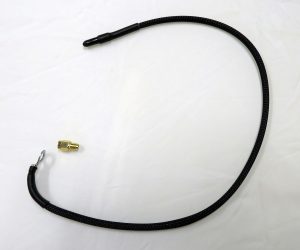
This simple addition balances the transmission from your whip antenna. Think of one person trying to ride on a teeter-totter; hard to get the correct ride. With two people (one on each end) the same teeter-totter rocks back and forth with much more ease & efficiency. The counterpoise works to allow the whip antenna to behave more like a true dipole and will transmit & receive much better.
If maximum range is your priority, you may want to consider a whip or “back pack” roll up style instead of the “rubber ducky” antenna. When it comes to range, the higher your elevation and the higher your antenna, the further your signal travels. My advise is to lose the “rubber ducky” except for close-in work. Better antenna will yield better range!
Having a higher quality “whip” or “back pack” style antenna, means your radio is set up for max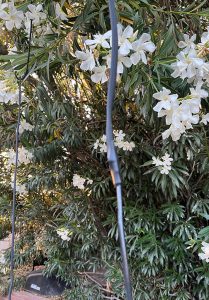 imim range. The picture to the left shows a tactical roll up antenna deployed in a tree for height. Most modern two-way radios have removable antennas, so upgrading your antenna is a low-cost, easy way to improve range performance. A better antenna is the first logical upgrade to invest in!
Mobile radio (vehicles) users will also find these handheld radio improvements very useful for your mobile setup. If you are a mobile (vehicle) radio user, be sure your antenna is mounted on the outside of your vehicle, preferably on the roof, so you can get the antenna as high as possible. Do notoperate your HT inside your car as it will “trap” most of the radio’s RF energy with you inside with the RF. Magnetic mount antennas are available as low as $25 and they work great.
Many years ago one of my son’s got his HAM license and bought a good quality dual band HT radio. He lived about 27 miles from me and was not able to transmit to me. He could hear me (scratchy at best), but I was pushing 50 watts to a repeater grade antenna at a height of 30 feet.
I got him a magnetic mount dual band antenna (same as you would use on your cars roof). I told him to put it on the center of his refrigerator (the metal fridge served as a ground plane just like the roof of a car). Problem solved! I could receive him at “full quiet” meaning his voice quality was excellent.
3. Terrain/Obstructions
Here is one area of handheld radio improvements that can be very effective and also free! We mentioned earlier that terrain, obstructions and buildings can & do affect the range. The reason behind this is that solid objects block & absorb radio signals. Metal can be quite problematic when it comes to radio communication; vegetation, trees, and even rain can reduce your signal.
Apart from solid objects, the landscape can be another factor. Many operators living in hilly areas find it troublesome to get adequate signal coverage. Like metals, signals cannot pass through hills, as well. If you are using your HT in a barren area, VHF is an excellent choice as is it travels greater distances. But to communicate in dense woods, or around buildings, you may want to consider UHF.
You may also want to note that when the signal passes through an object, it weakens the strength. That means, each time the RF energy passes through an object some of the energy is absorbed, thus the range is reduced. One of the greatest factors that affects range is the terrain and environment that the radio will be used in. In a perfect scenario, a HT radio can transmit and receive for many miles…but that is from an extremely elevated surface with completely flat terrain below.
Even from standing on the ground with no obstacles to interfere with the signal, the curvature of the earth cuts off the straight-lined radio waves at 6.5 miles (this is called the “radio horizon”). So, when trees, hills, valleys and buildings are thrown into the mix, it’s easy to see how a radio’s range can drop to under a half-mile. Atmospheric conditions including rain, snow, and dust storms also greatly affect range.
The best way to ensure you’re getting a maximum range is to know your terrain. If you will be operating in a fairly open area, then VHF will be best for you. The longer radio waves of a VHF radio give a greater range over open spaces, but they cannot penetrate through or bend around obstacles as well as the shorter waves of a UHF radio. That makes UHF the best choice for use around structures and in dense areas. Again, this is why you want a dual band radio!
4. Power or Wattage
Another essential factor in the distance a two-way radio covers is its power output. Having stronger signal strength, it can withstand weakening when passing through obstacles. This signal strength is measured in watts and results from the transceiver’s power output. The higher the output in watts a device has, the farther it transmits.
A Handheld two-way radio typically broadcasts at 1-5 watts. Similarly, a mobile vehicle radio may broadcast anywhere from 5 to 100 watts (typically 50 watts). Most radios allow to to adjust the transmit power. You can see, there’s a significant difference between the transmit power, and hence, the range.
The FCC has set a maximum wattage level for each radio type. Since most HT HAM radios operate with a small battery, a higher wattage would result in greatly reduced battery life. Use the minimum power required to achieve your communication as per FCC rules & guidelines.
Having maximum radio power will also help to improve range and coverage. Fully charging your batteries before radio use means you are transmitting and receiving with as much power and strength as possible. Consider having an extra battery pack or packs to give extra talk time.
For those of you who say “5 watts is not enough power”: I have been in the mountains camping and have used my HT set at 5 watts with my roll-up back pack antenna to reach repeaters that were over 70 miles away! Again, high elevation, good line of sight, and a good antenna are keys to range.
Just out of range? A Few Final Tips
When you are on the edge of your range, and you are struggling to communicate with other radios, there are a few tricks that you can use to increase your range just enough to hear or talk when you need it.
- Climb. Get to the highest point you can so your radio will have a greater line of sight.
- Stand Up. Most people don’t think doing something so simple would yield dramatically different results, but the simple act of standing can increase your range over 1 mile!
- Use High Power Mode. Enabling High Power Mode will give a significant boost to your signal which improves your coverage and can give a boost to your range in dense areas.
- Hold the radio away from your body (your body absorbs RF energy).
- ALWAYS operate with the antenna in a vertical plane.
- Get rid of the “rubber ducky”. Invest in a better antenna – you will be glad you did!
Summing Up
Handheld HAM radios, being lightweight come in handy in aiding communication wherever you go! Try using some of the handheld radio improvements that were covered here. Many relief operators also use the portable HAM radio (HT & Mobile) to assist during emergencies. Moreover, your HT can offer you many other versatile features like Morse code and GPS, as well as the newer Digital Modes.
There are several reasons why HT radios top the list for preppers and survivalists. A good quality HT radio boasts excellent power abilities, flexibility, and, most importantly, range. With the right HAM device and antenna, you can talk from the top of a mountain or a forest without needing a cell tower!
We hope the information given here will help you to improve your radio skills in attaining better range and performance from your Hand Held Radio! Just remember that handheld radio improvements are easy and they really work!