
OK, so just what is an Antenna Counterpoise? Understanding the word counterpoise helps us to know what exactly a counterpoise is and why and antenna counterpoise is so important for optimum signal radiation.
Counterpoise is French in origin. And “Counter” means counter or opposing, exactly as in English. “Poise” means weight. So the word literally means “counterweight”. In an antenna system a counterpoise is like a counter-balance. In simple terms, it is a ground plane that the antenna system can “mirror” itself in.
The Teeter-totter Anology
To understand how an antenna counterpoise functions, simply think of a playground “Teeter-totter”: If only 1 person gets on it sinks down on the side the person is on and does not do much even if the person jumps up and down. If another person gets on the opposite side it becomes balanced and will easily rock back and forth. The antenna without a counterpoise is like the Teeter-totter with only one person – it is not in balance.
With the antenna counterpoise the antenna is more “balanced” and the RF energy can radiate far more effectively. This is why the counterpoise is so good at making your radio receive and transmit far better. It is the same for Hand-Held Radios as it is for large Commercial Radio Antennas. They all will radiate RF energy better with a counterpoise.
Different Types of Antenna Counterpoise
There are many different styles and types of an antenna counterpoise, but, they all perform the same basic purpose. That purpose is to “balance” the transmission just like in the Teeter-totter example above. From your Handheld radio to large commercial and military antenna installations you will find the use of the counterpoise.
Handhelds use the metal shell that surrounds the radio to function as a counterpoise. This is not nearly as effective as a true counterpoise as we will discuss below. It is however, better than nothing.
Many mobile radio installations have the antenna or antennas mounted on the roof or trunk of the vehicle. This creates a “ground plane” which is highly effective in acting as a counterpoise to balance the transmission. A metal plate (think of the vehicle’s roof) makes a huge difference in signal propagation.
Many commercial antenna installations (often referred to as “antenna farms”) use a type of counterpoise that is referred to as a ground radial style of counterpoise. Many wire conductors radiate out from the antenna(s) to shape the radiation pattern of the antenna or antennas. This is often used by Radio Stations to shape the propagation of their signal to fit a populated area better.
The Tiger Tail - Especially for Handheld Radios
We often hear mention of the “Tiger Tail”. This is an antenna counterpoise made for handheld radios. The Tiger Tail is light, portable, and extremely effective in boosting the performance of a handheld radio. It functions to make the whip antenna function more like a true dipole antenna. This solution does far better at increasing the radiating efficiency as compared to using the radio’s metal case.
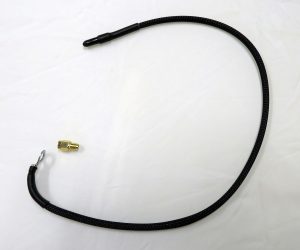
The Tiger Tail is shown in the picture. It gets it name from the fact that is hangs down and is flexible just like a Tiger’s Tail. The counterpoise in the picture is a Dual Band model that has a tuned element for the 2M & 7ocm bands.
We always recommend that the best investment for improving your handheld radio is to purchase a true whip antenna to replace the factory “rubber duck” antenna. Remember that the “rubber ducky” antennas are most often what are referred to as negative gain antenna which actually cause a loss in the radiated power of the radio.
A Tiger Tail counterpoise is the next additon to consider for your radio. To view a Dual Band Tiger Tail click here. They are inexpensive and they offer a truly impressive boost to the performance of your radio!
You Can Build Your Own Ground Plane Antenna!
If you have a desire to build things there is good news! It is easy to construct your own ground plane antenna for 2M & 70cm. This is more of a base type antenna as it would not stand up to the rigors of mobile or portable use.
Click here to view an article on building your own antenna. I have built many antennas and the only thing I would add would be to use 1/16″ Stainless Steel welding rod instead of the brass. The brass works just fine if you would rather use it.

